


Ever been at a gathering when a deck of cards comes out? Someone suggests ‘Hearts,’ and you have to politely decline because you never learned the rules. This simple guide will change that. In about five minutes, you’ll know everything you need to join in with confidence. Check out SEKAWAN78 to know more
Unlike most card games where you want high cards, Hearts is a game of clever evasion. The goal is to finish with the lowest score possible. You get points by collecting certain “penalty cards,” and you’ll spend the game trying to avoid them or force them onto your opponents. The most dreaded card is the Queen of Spades, worth 13 points, and every Heart card is worth one point. The winner is the player who skillfully dodges these 26 penalty points.
Each round follows a simple rhythm: dealing the cards, passing three cards to an opponent, playing thirteen rounds (called “tricks”), and finally, counting your score. Ready to master the game of Hearts?
Table of Contents
ToggleThe Objective: Avoid the Penalty Cards
The goal in Hearts is simple and surprising: finish with the lowest score. Think of it like a game of golf—the smaller your final number, the better you’ve done. Your score is determined by the penalty cards you’re forced to take during play.
Two types of cards will add to your score. The most feared card is the Queen of Spades (nicknamed the “Black Lady”), while every card from the suit of Hearts is also a penalty.
- All 13 Hearts: 1 point each
- The Queen of Spades: 13 points
In total, there are 26 penalty points up for grabs in every hand. Winning a round (or “trick”) is only bad if it forces you to collect these cards.
The Setup: How to Deal and Pass Cards
Getting a game of Hearts started is straightforward. You’ll need one standard 52-card deck and four players. The dealer shuffles and deals all the cards, one at a time, until each player has a 13-card hand. The Ace is the highest card in each suit, down to the 2.
Before the first card is played, you secretly choose three cards from your hand to pass to another player. This passing direction changes with each hand in a simple rotation: Left, Right, Across, Hold. In a “hold” hand, no cards are passed. You cannot look at the cards you’re receiving until after you have passed your own.
Passing is your first strategic move. It’s the perfect time to offload dangerous cards like the Queen of Spades or high-ranking Hearts. A clever tactic is creating a “void” by passing away all cards of a particular suit. If another player later leads that suit, you’ll be free to discard a penalty card on someone else, since you have none of that suit to play.
How to Play a Round (or a “Trick”)
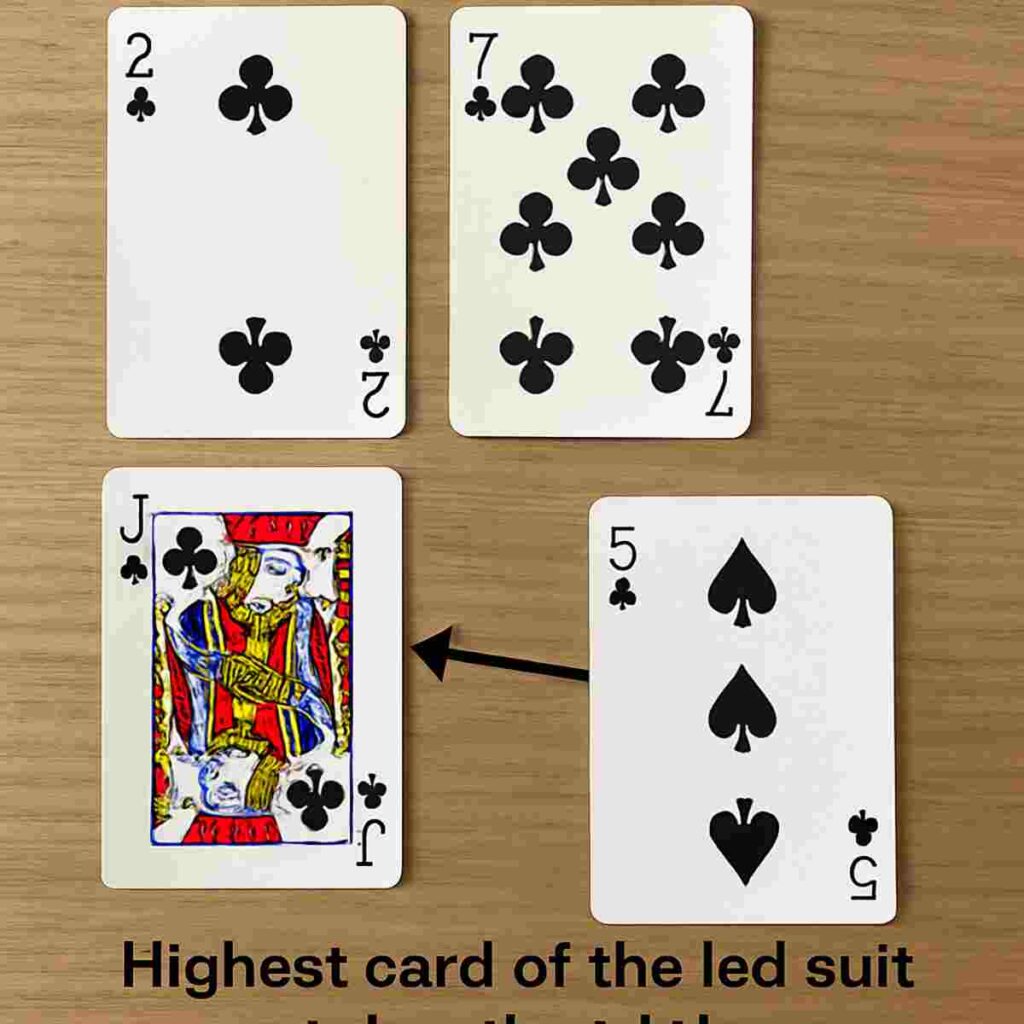
The game is played in thirteen rounds called “tricks.” The player holding the 2 of Clubs must lead the first trick by playing that card. Moving clockwise, the other three players must then play a card.
The single most important rule is that you must follow suit. If the first player leads with a Club, every other player who has a Club must play one. If you cannot follow suit, you are free to play any card from your hand. This is a crucial moment to get rid of a penalty card you don’t want, like a high Heart or the Queen of Spades. This is often called dumping or painting a card.
After all four players have laid down a card, the person who played the highest-ranking card of the suit that was originally led takes the entire trick. That player collects all four cards for their score pile and leads the next trick. They can lead any suit they like, with one major exception.
The Golden Rule: “Breaking” Hearts
At the beginning of a hand, you cannot lead a trick with a Heart card. The Hearts suit is considered “locked.”
This status changes the moment a player discards a Heart on a trick led by another suit (because they couldn’t follow suit). The instant that card hits the table, Hearts are “broken.” From that point forward, any player can lead a new trick with a Heart. This moment often changes the entire dynamic of the game, as players can now use their high Hearts to force points onto others.
Mastering when to break Hearts and when to dump your penalty cards is the key to going from simply playing Hearts to playing it well.
How to Count Your Score
After all 13 tricks are complete, it’s time to tally the score. Each player sifts through the pile of cards they’ve taken and counts their penalty cards. The other cards are worthless.
- Gather the tricks you took.
- Separate out all the Hearts and the Queen of Spades.
- Count the penalty points: You get 1 point for every Heart and 13 points for the Queen of Spades.
- Add your total to a running scoresheet. Your goal is to keep this cumulative total as low as possible.
The Ultimate Gamble: How to “Shoot the Moon”
“Shooting the Moon” is a high-risk, high-reward play that flips the game’s objective on its head. To succeed, you must capture every single penalty card: all 13 Hearts and the Queen of Spades.
If you pull it off, the scoring is reversed in your favor. You receive 0 points for the hand, and every other player gets 26 points added to their score. This move can catapult you from last place into the lead.
However, the gamble comes with a steep price. If you try to Shoot the Moon but miss even one penalty card, the plan backfires. You get all 26 penalty points for the hand, while everyone else scores 0. It’s a thrilling but dangerous maneuver.
How to Win the Whole Game
After each hand, points are added to a running total. The game continues until one player’s score reaches or exceeds 100 points. That player doesn’t win; they’ve simply triggered the end of the game.
The actual winner is the person with the lowest total score at that time. While 100 points is the traditional limit, your group can agree to a different target (like 50 for a shorter game) before you start.
Your First Game: 3 Simple Tips to Avoid Points
Knowing the rules is one thing, but playing with confidence is another. Focusing on a few simple habits can dramatically lower your score from your very first game.
- Force Out the Queen of Spades. If you don’t have the Queen of Spades, try to find it by leading with high Spades (Ace or King) early on. This pressures the player holding the Queen to play it on a trick someone else will take. This tactic is often called “bleeding Spades.”
- Lead From Your Longest Suit. If you have five or six Clubs but only one Diamond, it’s generally safer to lead with a Club. Leading from your “long suit” forces others to use up their cards in that suit, making it less likely an opponent can run out and dump a penalty card on your trick.
- Save Your Low Cards. Cards like the 2, 3, and 4 are your best friends. When you’re late in a trick and a high card has already been played, you can safely play your low card to “duck under” and guarantee you won’t take the trick. Hold onto them for safe plays later in the hand.
Quick Rules Cheat Sheet: Your Reference for Game Night
You no longer have to be a bystander when a deck of cards appears. The rules of Hearts are not about who takes the most tricks, but who masters the clever art of taking the least. The next time a game begins, gather your friends, deal the cards, and keep this guide handy.
For your first few hands, focus on the game’s rhythm—follow suit and try to avoid penalty points. Don’t worry about advanced strategy; simply dodging the Queen of Spades is a victory in itself. Welcome to the game.